Inside NSSF’s Ugx 180 Billion Stake In Kampala’s New Marriot
The National Social Security Fund’s decision to invest approximately UGX 180 billion (roughly US$50 million) for a 30 percent stake in the Kampala Marriott Hotel and Marriott Executive Apartments in Nsambya has become one of the more closely watched moves in Uganda’s institutional investment landscape this year.
The dual-branded property, developed by businessman Ponsiano Ngabirano through his Capital Shoppers Group, opened formally in late August 2026 when President Yoweri Museveni inaugurated it. NSSF’s entry as a minority shareholder places workers’ retirement savings alongside a major local entrepreneur in Uganda’s first Marriott Hotels-branded property and associated executive apartments. The implied valuation of the overall development sits around US$166–167 million.
The Investment in Context
NSSF manages one of Uganda’s largest pools of private-sector retirement savings. Its total assets have grown to roughly Shs 32.8 trillion, and the fund recently reported a strong performance that allowed it to credit members with a 22.53 percent return. In that environment, management has continued a strategy of diversifying beyond traditional government securities into equities, real estate, and now more deliberately into hospitality.
The Marriott stake was approved after more than a year of internal board review. It is structured as a 30 percent holding in the operating entity (sometimes referenced in connection with CS Hospitality), with the remaining 70 percent retained by Ngabirano’s interests. Returns are expected to come from room revenues, long-stay apartments, conferences, food and beverage, and related services rather than from a pure real-estate development play. NSSF Managing Director Patrick Ayota has publicly defended such decisions by arguing that individual investments should be judged as part of the overall portfolio rather than in isolation; different asset classes perform differently across cycles, and the fund’s mandate is long-term value for members.
This is not NSSF’s first foray into hotels. The fund has long held a stake in the Kampala Serena Hotel. Public reporting has noted that the Serena position produced relatively modest real returns over many years, with declining dividends in more recent periods and growth that lagged the fund’s broader performance. That history has made the larger Marriott commitment a natural point of scrutiny.
The Property and Its Developer
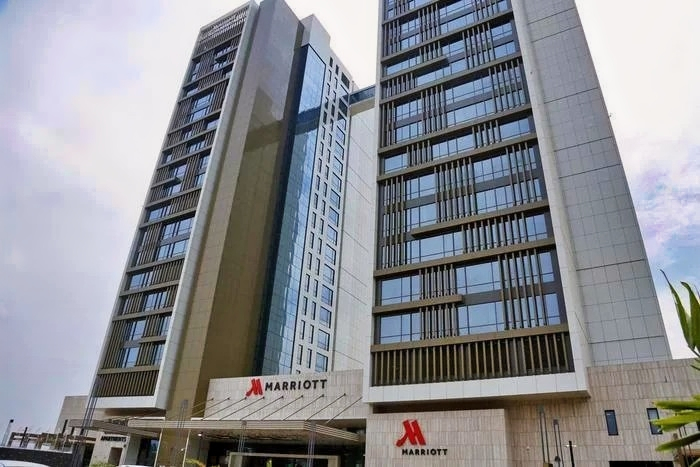
The development sits along Ggaba Road in Nsambya. It consists of two towers linked by a skybridge: roughly 181 hotel rooms and suites (including a presidential suite) and 96 fully serviced executive apartments ranging from one to three bedrooms. Amenities include multiple restaurants and bars, a spa, fitness facilities, an outdoor pool, and substantial meeting space centered on the Kampala Grand Ballroom, which can seat up to about 985 people. Soft opening occurred earlier in 2026, with the presidential inauguration on 27 August marking the formal debut of the Marriott Hotels and Marriott Executive Apartments brands in Uganda under a franchise arrangement with Marriott International.
Ponsiano Ngabirano built Capital Shoppers from a small grocery operation in Nakasero in the late 1990s into one of Uganda’s leading locally owned supermarket chains. The family has accumulated significant real-estate holdings, and the Marriott project represents a major expansion into premium hospitality. Local contractor SMS Construction played a significant role in delivery. The project has been credited with creating more than 350 direct jobs, with reports indicating that approximately 95 percent of those positions went to Ugandans and that a high proportion of procurement was sourced locally. Ngabirano has spoken of the property already employing hundreds and of expectations that employment will grow further.
President Museveni used the opening ceremony to endorse the NSSF investment explicitly. He welcomed the decision to put members’ savings into a local productive asset rather than foreign bonds, arguing that the former contributes more directly to Ugandan GDP, employment, and economic activity. He also praised Ngabirano’s trajectory from importer and retailer toward larger-scale domestic investment and thanked the church authorities who made land available for the site.
Parliamentary Questions and the COSASE Probe
On 5 November 2026—the same day the KeefaCom post circulated—Members of Parliament on the Committee on Commissions, Statutory Authorities and State Enterprises (COSASE), chaired by Muwada Nkunyingi, questioned NSSF management about the deal. Lawmakers sought assurances on financial prudence, expected returns, risk management, and the protection of workers’ retirement savings. They directed the fund to guarantee that members’ money remains secure. The scrutiny of the Marriott transaction has also prompted the committee to widen its look at NSSF’s broader hospitality exposure.
Such oversight is routine for a public fund of NSSF’s size, but the scale of the commitment and the relative newness of the asset have made the questions sharper. Critics point to the historical underperformance of the Serena stake and the inherent volatility of hospitality—occupancy rates, average daily rates, conference demand, operating costs, and external shocks all matter. Supporters note the year-long board process, the diversification logic, the job creation, the alignment with Uganda’s tourism ambitions, and the fact that NSSF remains a minority shareholder with the local developer retaining majority control and operational involvement.
Wider Economic and Tourism Backdrop
Uganda’s hospitality and tourism sectors are receiving heightened attention as the country prepares to co-host the 2027 Africa Cup of Nations (AFCON PAMOJA) with Kenya and Tanzania. Tourism receipts have been reported in the region of US$1.6 billion in recent periods, with visitor numbers rising. Authorities and industry players view the tournament as a platform to showcase the country beyond football—wildlife, culture, food, and upgraded accommodation—and to encourage longer stays and repeat visits. The Uganda Tourism Board has pursued partnerships, including with CAF, to market Destination Uganda. Government has directed resources toward stadiums, related infrastructure, and hospitality upgrades in host areas. A high-end, internationally branded property in Kampala adds capacity for business travelers, conferences, and higher-spending visitors .
For a pension fund, the attraction is exposure to an asset class that can generate both operating income and potential capital appreciation while supporting domestic economic activity. The risks include the capital intensity of hotels, the time needed to stabilize occupancy after opening, competitive pressures in the Kampala market, and the possibility that returns lag other parts of the portfolio for years. Minority stakes also mean limited control over day-to-day decisions, making the quality of the operating partner and the franchise brand important.
Balancing Returns, Risk, and Public Interest.
NSSF’s overall portfolio remains heavily weighted toward fixed income, with growing equity and a smaller real-estate allocation. Strong recent returns have been driven by a combination of realized income (interest, dividends, rent) and mark-to-market gains. The fund has a stated return promise relative to inflation. Adding hospitality expands the real-asset and operating-business exposure, which can be valuable in an inflationary environment or when tourism demand rises, but it also introduces sector-specific volatility.
Members themselves have sometimes referred, half-jokingly, to being “co-owners” of the Marriott because their contributions helped fund the stake. That framing underscores both the collective nature of the savings and the responsibility that comes with investing other people’s retirement money. Transparent reporting on performance metrics for the investment—occupancy, revenue per available room, contribution to fund income, and any distributions—will be important as the property matures.
The parliamentary process now underway is one mechanism for testing the assumptions that underpinned the decision. Questions about valuation relative to construction cost and expected cash flows, about risk-mitigation measures, about alignment with the fund’s strategic asset allocation, and about lessons from the Serena experience are legitimate. At the same time, the investment sits within a larger pattern of Ugandan institutional capital being deployed into local productive assets rather than solely into government paper or foreign instruments. Museveni’s public support framed it that way; COSASE’s questions ask whether the framing is matched by expected risk-adjusted returns for members.
Looking Ahead
The Kampala Marriott is still in its early operating period. Its ability to deliver for both the majority owner and the NSSF minority stake will depend on execution, market conditions, the trajectory of business and leisure travel, and the broader performance of Uganda’s tourism and conference sectors ahead of and beyond AFCON 2027. For NSSF, it is one holding among many; the fund’s long-term track record will continue to be judged on the aggregate results credited to members’ .
Ongoing reporting from COSASE sessions, NSSF’s own disclosures, and the hotel’s operating results will determine whether the investment is ultimately viewed as a successful diversification or as a cautionary case in the stewardship of retirement savings.
This synthesizes publicly reported facts from Ugandan and regional business coverage, parliamentary reporting, and statements around the August opening. Specific internal valuations, detailed cash-flow projections, and future performance remain subject to further disclosure and market outcomes.
📩 Email us: kamunyereports@gmail.com
📲 WhatsApp us: +256705569885
Your story matters—share it with us today! 🗞️🔥