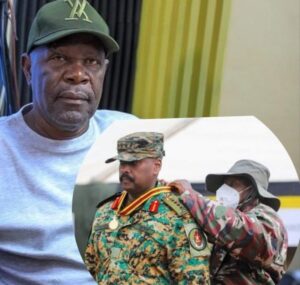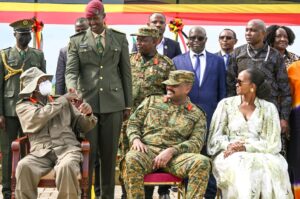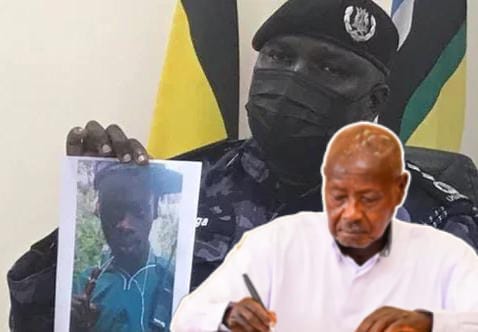
Tension and Tears: What Really Happened When Gen Salim Saleh Met Gen Sejusa Again – Both Generals Shed Tears
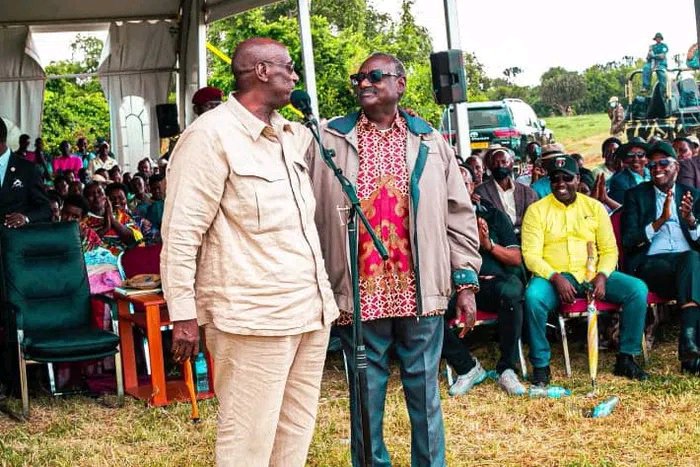
Two of Uganda’s most recognisable military figures—Gen Caleb Akandwanaho, widely known as Salim Saleh, and Gen David Tinyefuza, better known as David Sejusa—shared an unexpectedly emotional reunion in Ssembabule district over the weekend.
The two veteran soldiers, once close comrades and later separated by years of political tension and Sejusa’s long period of self-imposed exile, found themselves face-to-face at a public gathering, where the weight of history appeared to settle between them. The meeting was anything but ordinary; witnesses described a moment that seemed to dissolve decades of silence and estrangement.
Their reunion unfolded at the funeral of Margaret Kibazibira, a paternal aunt to both Gen Saleh and President Yoweri Museveni. At the event, Gen Saleh, who now serves as the National Coordinator of Operation Wealth Creation (OWC), appeared deeply moved when he caught sight of his former colleague. Unable to conceal his emotions, he stepped forward and invited Sejusa for a long-awaited embrace.
“I am so happy to see my colleague, Daudi Tinyefuza. We just embraced each other, he almost threw me to the ground. We greeted each other and cried tears,” Gen Saleh remarked.

He went on to reveal that reconnecting with Sejusa had been a personal mission in recent years.
“I have searched for this man for a long time; I looked for his phone number but he hid from me. I want him to come back into his camp. Praise be to God.”
Gen David Sejusa remains a towering figure in the history of the National Resistance Army (NRA) and the Uganda People’s Defence Forces (UPDF). He was part of the core team of bush-war fighters who helped usher the current government into power in 1986. Yet despite these deep roots, his relationship with the ruling National Resistance Movement (NRM) became increasingly strained over time.
The most dramatic rupture came in 2013. At the time, Sejusa was serving as the Coordinator of Intelligence Services when he authored a controversial letter alleging a plan to eliminate senior government officials opposed to what he described as a looming succession agenda—popularly referred to as the “Muhoozi Project.” The letter triggered shockwaves within the state and quickly deepened the rift between Sejusa and the establishment he had once defended.
Fearing for his safety, Sejusa fled Uganda soon after, beginning a chapter of self-imposed exile in the United Kingdom. From abroad, he became an outspoken critic of the government, a stance that placed him even further at odds with the UPDF hierarchy.

His return to Uganda in late 2014 marked the start of a gradual, cautious process of reintegration. Although he faced court-martial proceedings for his extended absence, he, along with several other senior officers, was formally retired from the UPDF in 2016. In the years that followed, Sejusa largely kept out of the public eye, rarely making headlines and maintaining a noticeably quiet profile.
That is why his heartfelt and very public reunion with Gen Saleh—who is not only a long-time comrade but also President Museveni’s younger brother—carried a symbolic weight that was not lost on observers. It hinted at the possibility of a deeper reconciliation, perhaps even the closing of one of the most significant personal and political rifts within Uganda’s military history.
Gen Saleh’s call for Sejusa to “come back into his camp” seemed to capture more than nostalgia; it suggested both a personal longing to restore an old friendship and a political desire to see the once-influential general fully reconnected to the NRM fold.
Whether this emotional encounter marks a new chapter or simply a moment of reflection remains to be seen, but for many who witnessed it, the reunion served as a powerful reminder of the enduring bonds—and complex fractures—within Uganda’s revolutionary generation.
📩 Email us: kamunyereports@gmail.com
📲 WhatsApp us: +256705569885
Your story matters—share it with us today! 🗞️🔥