Museveni Congratulates Tanzania’s Samia Suluhu on Re-Election, Pledges Stronger Regional Ties
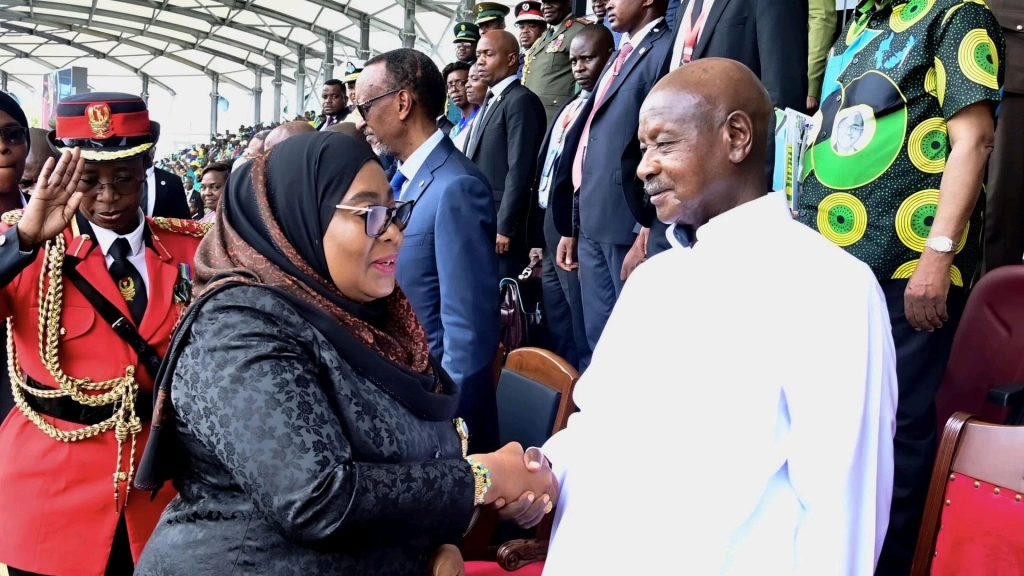
President Yoweri Kaguta Museveni has joined a growing list of world leaders in congratulating Samia Suluhu Hassan, President of the United Republic of Tanzania, and her ruling party, Chama Cha Mapinduzi (CCM), following her recent re-election.
In his congratulatory message, Museveni described President Suluhu’s victory as a testament to the people’s faith in her leadership, commending her continued efforts to steer Tanzania toward development and stability.
“This victory reflects the confidence that the people of Tanzania have in her leadership and vision,” he said.
The Ugandan leader further highlighted the deep and historic bond between Uganda and Tanzania—ties that stretch back to the early days of independence and liberation struggles in the region. He expressed optimism about working closely with President Suluhu to expand cooperation in trade, infrastructure, and regional integration for the prosperity of both nations.
Museveni noted the longstanding friendship between Uganda and Tanzania and expressed his eagerness to work with President Suluhu to deepen collaboration in trade, infrastructure and regional integration for the prosperity of both peoples.

President Suluhu’s re-election follows last week’s general elections in Tanzania, a contest that has drawn both celebration and criticism at home and abroad.
According to Tanzania’s Independent National Electoral Commission, the ballot held on 29 October 2025 saw her secure approximately 97.6 percent of the valid votes—an overwhelming margin that reaffirms her dominance on the political stage. However, her two main rivals from major opposition parties were barred from participating, leaving the field largely to minor-party contenders.
The electoral process has been described as intensely controversial. Opposition groups swiftly rejected the results, arguing that the exercise was neither credible nor competitive. They accused the electoral body of bias and condemned the exclusion of key opposition leaders, which they said turned the election into a formality rather than a true democratic contest.
Protests erupted in several urban centers, including Dar es Salaam, on election day and in the days that followed. Security forces were deployed to contain the unrest, and at least ten deaths have been confirmed by the UN human-rights office—though opposition figures claim the actual number could be significantly higher.
The raid on Tembo Trek Courts Hotel, captured in footage that circulated widely on social media, further heightened public concern about the government’s response to dissent.
Political analysts have been closely following developments in Tanzania. One observer, Mwenda, drew parallels between the situation and recent events in Cameroon, where the world’s oldest sitting president, Paul Biya, was declared the winner of another contentious seven-year term at the age of 92. Mwenda based his prediction on the region’s broader pattern of incumbents maintaining power amid calls for reform.
Despite the controversy, President Suluhu struck a conciliatory tone in her victory speech. “It’s time to unite our country and not destroy what we’ve built over more than six decades,” she said, pledging to involve all security agencies in ensuring peace and stability.
The campaigns, which began on September 29, were largely peaceful compared to past elections, with no major running battles between security forces and opposition supporters. Still, analysts caution that the post-election period could yet prove volatile as opposition groups continue to challenge the results.

Observers note that while Suluhu’s victory consolidates CCM’s political dominance—unchallenged since Tanzania’s independence—it also raises questions about the country’s democratic trajectory and the space for political pluralism.
Against this backdrop, President Museveni’s congratulatory message carries symbolic weight. His emphasis on regional friendship, cooperation, and integration comes at a time when East African nations are navigating complex political transitions and shifting alliances.
Uganda and Tanzania, both founding members of the East African Community (EAC), share strategic interests that go beyond politics. From cross-border trade to infrastructure projects like the East African Crude Oil Pipeline, the two countries continue to view each other as key partners in driving regional growth.
By reaffirming his commitment to work with President Suluhu, Museveni sends a clear message that Uganda values stability and partnership in the region. Despite international scrutiny over Tanzania’s elections, Kampala appears keen to focus on strengthening diplomatic and economic cooperation rather than wading into internal political debates.
As both nations look ahead, their collaboration could play a pivotal role in shaping the East African region’s path toward integration, economic transformation, and collective resilience.
📩 Email us: kamunyereports@gmail.com
📲 WhatsApp us: +256705569885
Your story matters—share it with us today! 🗞️🔥