From Obote’s Raid to Besigye’s Mass: The Cathedral That Won’t Escape Politics
What unfolded at Lubaga Cathedral on Monday was not just another tense church-state moment. It landed on a date soaked in history—exactly 44 years after armed soldiers loyal to President Milton Obote stormed the same sacred space and stopped Mass at gunpoint.
Back on February 24, 1982, Uganda witnessed one of the most brazen confrontations between altar and authority. During an Ash Wednesday service at Lubaga Cathedral, soldiers from the Uganda National Liberation Army (UNLA) marched in with weapons drawn and shut down the liturgy midstream. The Mass had begun at 8:00 a.m., led by three priests and attended largely by schoolchildren and devoted Catholics marking the beginning of Lent with the solemn imposition of ashes. The homily had just begun when boots and guns shattered the silence.
According to archived accounts, including reports published the following day in the Catholic newspaper Munno, armed men walked straight to the altar and ordered the priests to stop praying. They pointed rifles at clergymen who were in full vestments and forced them to abandon the sanctuary. Eyewitnesses recall chaos—worshippers scrambling for safety as soldiers dragged priests outside like criminals. The armed men then combed through the cathedral premises inch by inch: the presbytery, church archives, the residence of Emmanuel Cardinal Nsubuga, and adjacent buildings. Their alleged mission? To hunt down weapons or guerrilla fighters.
They found nothing. No guns. No rebels. No smoking barrel. But that did not stop them from looting property and detaining around 60 individuals who had sought refuge within the church compound.

The raid came a day after a bold guerrilla assault by Dr. Andrew Lutakome Kayiira’s Uganda Freedom Movement (UFM) on Malire Barracks at Lubiri Palace in Mengo. Rebels reportedly shelled the military installation—some accounts claimed from positions near the Rubaga Cathedral compound—killing two UNLA soldiers in an effort to destabilize Obote’s regime. Although the army repelled the attack, suspicion clung to the cathedral like smoke after gunfire. And in that suspicion, the state crossed a line.
But the Church did not fold.
Cardinal Nsubuga, revered by Kampala’s Catholics as a fatherly figure of immense moral authority, issued a blistering four-page pastoral letter condemning the intrusion as “godless” and sacrilegious. He denounced the humiliation of priests and the desecration of a sacred space. Then he drew a line in the sand: the government must apologize—or the Catholic Church would boycott all state functions.
It was not empty rhetoric. On March 18, 1982, Obote met the cardinal at Parliament, admitted the army had erred, and formally apologized. As a gesture of reconciliation, the president agreed that Cardinal Nsubuga would visit Luzira Prison to check on political detainees. The confrontation cooled—but the message was clear: the Church would resist state overreach, but it would do so strategically, not recklessly.
Fast forward four decades.
Some say history repeats itself. Others insist it merely rhymes. The irony is hard to ignore: on February 23, 2026—almost to the day—Lubaga Cathedral was again thrust into a political storm.
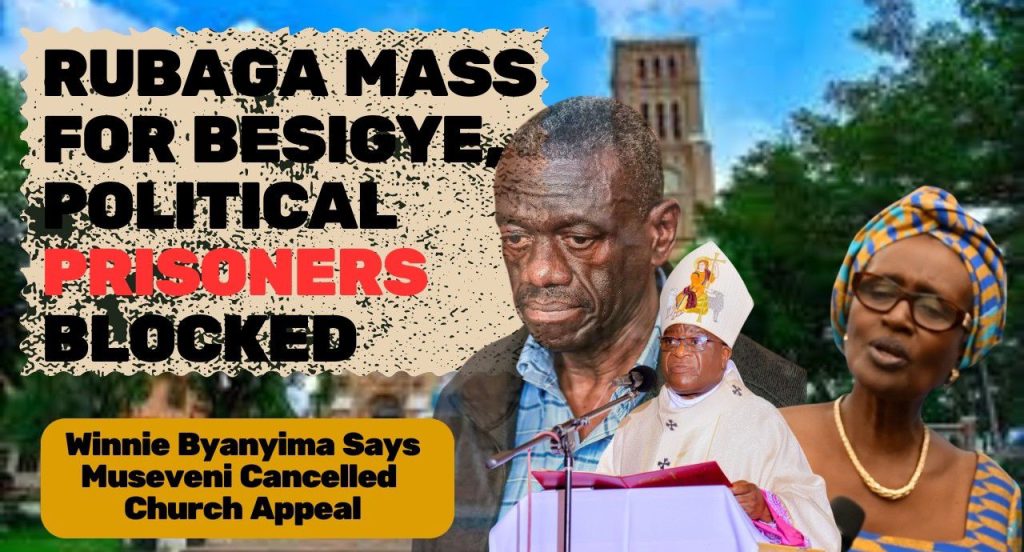
This time, the trigger was a special Mass organized to pray for detained opposition leader Dr. Kizza Besigye, who has been held for over a year on treason charges amid reports of worsening health. The service was also intended to pray for other prisoners and the sick. But before the liturgy could proceed, it was abruptly postponed—reportedly after direct intervention by President Yoweri Museveni.

Winnie Byanyima, Besigye’s wife, publicly stated that the president’s involvement led to the archbishop reluctantly shelving the Mass, despite earlier appeals to let it continue. The optics were explosive. Hundreds of Besigye supporters gathered anyway, filling the cathedral grounds with hymns and impromptu prayers. Without clerical leadership, the faithful transformed the space into a spontaneous act of protest and solidarity.
Besigye, a four-time presidential contender and founder of the Forum for Democratic Change (FDC), has long been Museveni’s most resilient political adversary. His prolonged detention has stirred anger and concern across sections of the population. The Church’s decision to postpone the Mass poured fuel on an already burning debate.
Critics accused the Catholic hierarchy of capitulating to political pressure. But historian Dr. Robert Ojambo, head of the Department of History, Archaeology, and Heritage at Kyambogo University, argues that such outrage oversimplifies a far more calculated tradition.
According to Ojambo, the Catholic Church in Uganda has survived turbulent regimes precisely because it chooses its battles carefully. It has never confused courage with recklessness. From independence onward, friction between church and state has been constant—stretching back to Archbishop Joseph Kiwanuka’s clashes with both Kabaka Mutesa and Obote.
During Idi Amin’s brutal dictatorship, the Church openly condemned atrocities, including the expulsion of missionaries and threats against clergy such as Cardinal Nsubuga. Yet it avoided direct confrontation that could have led to annihilation—unlike the fate suffered by Anglican Archbishop Janani Luwum, who was murdered in 1977.
The Catholic hierarchy saw what open defiance could cost. They chose a different route: measured statements, quiet diplomacy, and moral guidance instead of dramatic showdowns. Even when priests like Fr. Clement Kigundu were murdered and others abducted, the Church calculated its moves with cold awareness of the risks.
Under Obote’s second regime, as civil war ravaged the Luwero Triangle, Catholic leaders were widely believed to sympathize with rebels fighting the government. Yet they avoided overt alignment. That restraint preserved their institutional integrity and ensured survival when regimes collapsed.
Today, Ojambo suggests, the same cautious instinct is at work. The Church operates schools, hospitals, and social programs that serve millions. A frontal collision with the state could jeopardize not just sermons, but livelihoods and services across the country. In a polarized political environment, survival itself is a strategic victory.
This balancing act is not new. It dates back to Archbishop Joseph Kiwanuka, the first African bishop south of the Sahara and later Archbishop of Rubaga. In his landmark 1961 pastoral letter, “Church and State: Guiding Principles,” issued amid heated pre-independence elections, Kiwanuka mapped out boundaries: the state governs temporal affairs, but the Church safeguards moral truth. Political leaders must respect ethical authority, and the Church must avoid partisan captivity.

Successive bishops have followed that script—issuing pastoral letters on elections, governance, peace, and justice without formally aligning with any party. They have criticized wrongdoing while avoiding total rupture.
Just days before the recent Lubaga controversy, the Church marked 147 years since the arrival of the first Catholic missionaries—Fr. Simeon Lourdel (Mapeera) and Brother Amans Delmas—at Kigungu in Entebbe in 1879. During those commemorations, Archbishop Paul Ssemogerere reflected on President Museveni’s recent praise of Janani Luwum as a martyr and warning against bad leadership.
Museveni, speaking during national prayers in Kitgum to honor Luwum’s 49th martyrdom anniversary, condemned dictatorship and urged leaders to persuade rather than intimidate. The irony was not lost on observers.
Archbishop Ssemogerere responded by challenging leaders to match rhetoric with action. Yet he also invoked Pope Francis, urging believers to “retain themselves” in the face of provocation. Dialogue, he insisted, must trump confrontation—even when tensions flare.
That is the Catholic playbook in Uganda: resist, but survive. Criticize, but endure. Push back, but do not self-destruct.
Still, for many Catholics and opposition supporters, patience feels dangerously close to passivity. They ask whether caution has become compromise. Whether restraint has drifted into retreat.
Forty-four years after soldiers desecrated the altar at Lubaga, the battleground has shifted from rifles to phone calls and political pressure. The weapons are subtler. The stakes remain enormous.
And once again, the Catholic Church stands in the crossfire—torn between prophetic defiance and institutional preservation, between moral thunder and strategic silence.
📩 Email us: kamunyereports@gmail.com
📲 WhatsApp us: +256705569885
Your story matters—share it with us today! 🗞️🔥