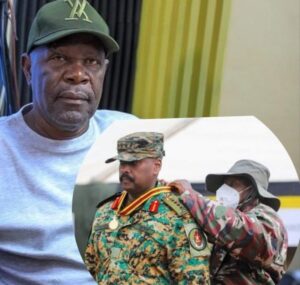
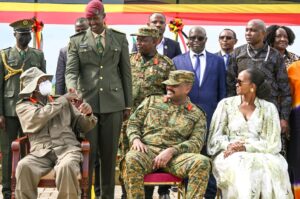
Bobi Wine’s Brother Chairman Nyanzi To Testify Against NUP Members Filmed Doing Military Drilling – Secrets Emerge On How He Leaked Their Names To CMI
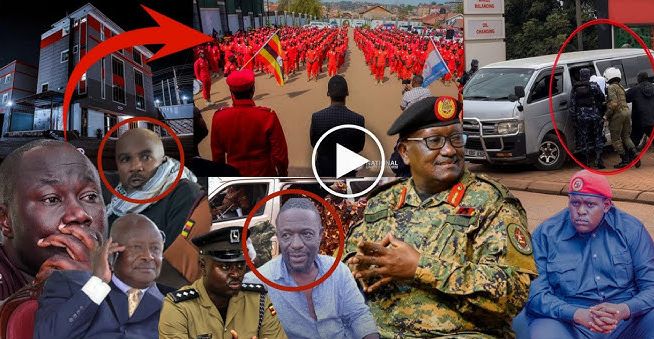
Fred Nyanzi Ssentamu, a senior figure in Uganda’s opposition National Unity Platform (NUP), has publicly rejected claims that he is cooperating with state prosecutors in the controversial Kanyanya unlawful military drilling case, pushing back against reports that he has been lined up as a key witness against fellow party supporters.
Nyanzi—widely known as Chairman Nyanzi and the brother of opposition leader Bobi Wine—issued a strongly worded statement on Saturday morning, distancing himself from the prosecution’s case and accusing authorities of attempting to use his name to advance what he described as politically driven charges.
“My attention has been drawn to the malicious claims by the state prosecutors that I am one of their witnesses in the ongoing politically motivated harassment and persecution of our comrades at Kanyanya,” Nyanzi said.

At the center of the dispute is a case in which several NUP supporters are facing allegations of unlawful military-style drilling in Kanyanya, a suburb of Kampala. The case has drawn significant political attention, with opposition figures describing it as part of a broader crackdown on dissent, while authorities maintain it is grounded in law enforcement.
Nyanzi, however, categorically denied any involvement with investigators in relation to the case. He insisted he has never recorded a statement with any state authority and suggested that the prosecution’s move is part of a wider strategy to intimidate opposition figures.
“I would like to state from the onset I have never recorded any statement before any authority regarding this matter. I was equally abducted, held incommunicado, tortured, and eventually dumped on the street on the basis of similar malicious charges,” he said.
While acknowledging that courts have the legal mandate to summon witnesses, Nyanzi argued that such powers should be exercised impartially and not, in his view, to advance political objectives.
“Such power should be used in the interest of justice and not enabling the prosecutors who clearly have been deployed as weapons to harass, intimidate and instill fear in the country, particularly targeting members and leaders of National Unity Platform,” he said.
He further alleged that the state’s actions were aimed not only at prosecuting individuals but also at weakening cohesion within the opposition party itself.

“In the instant case it is very clear that the objective of the state isn’t only to persecute leaders of NUP but also cause disharmony, mistrust and break cohesion within the organisation,” he said.
Maintaining that the accusations are unfounded, Nyanzi expressed confidence that the case would not stand in court.
“I would like to firmly state that this malicious development is built on falsehoods and will eventually collapse like all the other lies fabricated against NUP and its leaders,” he said.
He also used the statement to renew calls for the release of individuals he described as political prisoners and urged Ugandans to remain focused despite what he termed “regime side shows.”
**Supporters react with unease**
The emergence of Nyanzi’s name on the prosecution’s witness list has stirred unease within NUP ranks, with some supporters questioning the circumstances under which he may have been linked to the case.
On social media, speculation quickly spread, with some party loyalists calling for clarity. Ninye Tabz, an aide to Bobi Wine, posted on X:
“Chairman Nyanzi should come clean and tell us what statement he recorded when he was arrested for that parade! At this point, we may not know what we are dealing with but I can authoritatively say that the state is mainly relying on Nyanzi’s statement to persecute our comrades!”
The comments reflect broader concern among sections of the party’s grassroots, where fears about internal divisions have occasionally surfaced amid mounting legal pressure on opposition figures.
However, legal analysts note that being listed as a prosecution witness does not necessarily imply voluntary cooperation. Courts have the authority to compel individuals to testify if they are believed to possess relevant information, regardless of their willingness or political affiliation.
Nyanzi himself was previously arrested in connection with the same case, a detail that adds further complexity to his inclusion on the witness list.
As the Kanyanya case proceeds, the controversy surrounding Nyanzi’s alleged role is likely to remain a focal point—highlighting tensions between the state and opposition actors, as well as internal dynamics within one of Uganda’s most prominent political movements.
📩 Email us: kamunyereports@gmail.com
📲 WhatsApp us: +256705569885
Your story matters—share it with us today! 🗞️🔥