Agnes Nandutu: From Poverty to Power to Prison in Shocking Fall From Grace
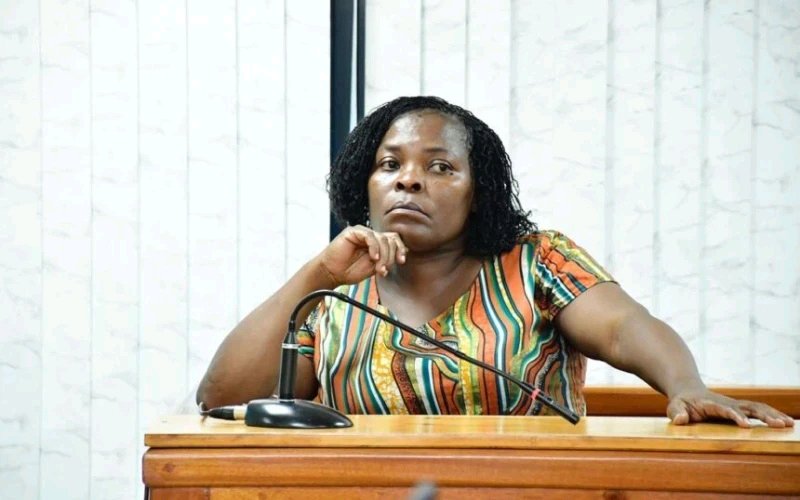
The life and career of Agnes Nandutu traces a striking arc through hardship, public acclaim and, most recently, criminal conviction—an evolution that has gripped public attention and stirred debate about leadership, accountability and redemption in Uganda.
Long before she stepped into the political spotlight, Nandutu’s story began in the rugged hills of Bududa District, where she was raised in a fractured family following her parents’ separation. Her upbringing, she has said in past interviews, was marked by instability and poverty, moving between relatives while trying to pursue an education under difficult conditions.
“I had a troubled childhood,” she once said in a television interview. “We would first dig at home before going to school.”
The hardships extended into her schooling years. Nandutu has recalled wearing shoes for the first time only in Primary Seven, and even then, only for a school drama competition in Mbale. Despite these limitations, she excelled academically at Bumwali Primary School, earning five aggregates—a performance she would later attribute to determination and natural ability rather than privilege.

Yet economic realities soon disrupted her ambitions. By the age of 18, she had dropped out of school, unable to sustain her education. In search of opportunity, she travelled to Nairobi with her mother, but the experience proved equally challenging. Returning to Uganda, she took on low-paying jobs, working as a cook and later as a barmaid to survive.
Her breakthrough came years later in the media industry. After building experience across radio and print, she joined NTV Uganda in 2008, where she rose to national prominence. Known for her sharp delivery and commanding presence, she became a familiar face through programmes such as *Point Blank* and *People’s Parliament*, earning recognition as one of the country’s notable broadcast journalists.
That visibility paved the way for her entry into politics. In 2021, she successfully contested for the Bududa District Woman Member of Parliament seat as an independent candidate. Her victory marked a transition from media influence to legislative power, further solidified when Yoweri Museveni appointed her State Minister for Karamoja Affairs.
In that role, Nandutu was tasked with overseeing programmes aimed at stabilising the Karamoja sub-region, an area long affected by poverty, insecurity and underdevelopment.
However, her rise has since been eclipsed by a dramatic legal downfall.
On April 10, Uganda’s Anti-Corruption Court sentenced her to four years in prison over her involvement in the diversion of relief materials intended for vulnerable communities in Karamoja. In a ruling delivered by Justice Jane Okuo Kajuga, the court found that Nandutu had abused positions of “impeccable trust” in both the executive and legislative arms of government.

She was also barred from holding public office for 10 years, effectively halting her political career in the near term.
The case centred on 2,000 iron sheets that prosecutors said she received from a government programme designed to support disarmament efforts and assist vulnerable groups, including elderly residents and reformed Karachuna. According to the court, only a fraction of the materials reached intended beneficiaries, with just 1,000 of 10,000 iron sheets distributed as planned.
“These are offices held in trust for the good of the people and the country,” the judge said, noting that the programme had been designed to restore peace and stability in the region.
In sentencing, the court weighed both aggravating and mitigating factors under Uganda’s guidelines. While Nandutu’s legal team cited her status as a first-time offender, her role as a single mother of seven and her care for an elderly parent, the judge ruled that the seriousness of the offence outweighed those considerations. She also noted the absence of updated medical evidence suggesting Nandutu was unfit to serve a custodial sentence.
The court declined to impose a fine in place of imprisonment, arguing that the statutory maximum—Shs 3.2 million—was insufficient.
“The sentencing must be true to the crime committed,” Justice Kajuga said. “A fine of 3.2 million is so low that it makes it difficult to hand down to convicts.”
The case forms part of a broader corruption scandal involving the alleged diversion of iron sheets in 2023, which drew in several senior officials. Among those implicated were former Karamoja Affairs Minister Mary Goretti Kitutu, State Minister for Finance Amos Lugoloobi and Speaker of Parliament Anita Among. While some faced charges, others returned the materials or pursued legal challenges, with proceedings evolving differently across cases.

The scandal also attracted international scrutiny. In 2024, the United Kingdom imposed sanctions on Nandutu, Kitutu and Among, including travel bans and asset freezes. The United States later announced similar measures, citing the need to promote accountability among public officials.
For many observers, Nandutu’s journey—from a childhood defined by deprivation to national prominence, and now to imprisonment—reflects both the possibilities and pitfalls of public life. Her story, once seen as inspirational, now stands as a cautionary tale about power, responsibility and the consequences of its misuse.
📩 Email us: kamunyereports@gmail.com
📲 WhatsApp us: +256705569885
Your story matters—share it with us today! 🗞️🔥