
Exclusive!! Inside The Billions Lost At Uganda Airlines – Political Games, Séx Politics And Luxury Exposed
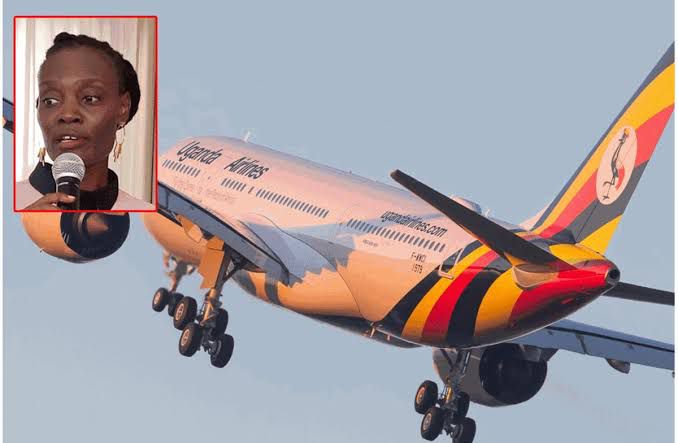
Parked at Entebbe International Airport, one of Uganda Airlines’ sleek Bombardier jets, painted in the bright red, black, and yellow of the national flag, looks every bit the symbol of pride and ambition the government promised when it revived the national carrier in 2019.
But beneath the glossy surface of its aircraft lies a sobering truth: the dream of a Ugandan flag flying proudly across Africa’s skies has come with staggering costs, mounting losses, and a bitter debate over whether politics, not business sense, has steered the airline off course.
In 2018, the government signed a deal with Canadian firm Bombardier to purchase four CRJ900 jets, each costing $27.3 million, as the foundation of Uganda Airlines’ revival. Configured with 76 seats, including 12 in business class, the planes were tailored for regional flights.
The first deliveries in 2019 signaled a confident return to aviation for a country whose national airline had collapsed nearly two decades earlier. The fleet grew quickly. Two Airbus A330-800neos were added for long-haul routes to Dubai, Mumbai, and later London.
More recently, the airline brought in an Airbus A320-200 through a short-term leasing arrangement with a Lithuanian carrier. Today, Uganda Airlines serves 17 destinations, from African hubs like Nairobi, Kinshasa, and Johannesburg to intercontinental routes linking Uganda with Europe, Asia, and the Gulf.

On paper, the expansion looks impressive. In practice, it has been far costlier than expected.
LOSSES IN THE BILLIONS
Since its relaunch, Uganda Airlines has operated at a loss every year. The Auditor General’s 2023/24 report showed a staggering Shs 237 billion loss. Ticket fraud alone accounted for Shs 140 billion, while another Shs 170 billion came from ticket price manipulation involving staff and travel agents.
CEO Jennifer Bamuturaki, appearing before Parliament’s watchdog committee last week, admitted fuel, crew allowances, and aircraft depreciation are eating into revenue.
Maintenance is another heavy drain, swallowing nearly 20% of the airline’s total budget. Although Uganda Airlines recently gained approval to perform basic repairs at Entebbe, major maintenance still takes place abroad at certified centers, a costly arrangement.
A fully equipped maintenance hangar at home, experts say, would cost at least $50 million (Shs 183 billion) but could dramatically reduce expenses. Adding to the pressure is the CRJ program itself.
Bombardier sold the line to Mitsubishi Heavy Industries in 2019, which has since phased out production. Without new aircraft rolling off the assembly line, spare parts are harder to source and more expensive.
“There is no ongoing production,” committee chair Medard Sseggona told parliament. “Once production stops, spare parts become scarce and costly, or you’re forced to settle for used components.”
The committee has now summoned former airline executives who oversaw the decision to buy the CRJs in the first place. Nathalie Scott, media relations manager at MHI RJ Aviation, confirmed to The Observer that the company has stopped producing CRJ-900LR aircraft.
“We are no longer manufacturing the CRJ-900LR,” she said.
BABU EXPLAINS
For veteran aviation expert Captain Edward Francis Babu, none of these problems is surprising. In his view, Uganda Airlines was set on the wrong course from the very beginning.

“When you’re starting any business, including an airline, it must be founded on a business case, not politics,” he said.
“Unfortunately, Uganda Airlines was a blessing in disguise that was never allowed to mature.”
Uganda’s location, he explained, is enviable. With Entebbe sitting almost halfway between Cairo and Cape Town, and between Dakar and Mumbai, it could have become a natural hub for Africa.
But poor planning, he argued, squandered that advantage. Instead of starting small with key regional routes like Nairobi, Juba, and Mogadishu, the airline rushed into intercontinental flights to Europe and Asia.
“They should have focused on routes with guaranteed traffic. You build gradually. Instead, they went for show,” he said.
Babu also criticized the decision to buy aircraft outright instead of leasing, which is common for new airlines because it lowers risk and allows flexibility.
“I told them: don’t buy. Lease aircraft. After a few years, change models based on route performance. They didn’t listen.”
He faults the choice of CRJs too.
“In the region, most carriers fly Embraers or Airbuses. That means they can share maintenance facilities. Uganda picked an aircraft no one else nearby uses, complicating ev- everything.”
THE NUMBERS BEHIND THE DREAM
Running an airline, Babu reminded, is brutally expensive.
“The break-even point for an airline is far off, five to seven years. The internal rate of return in this region is below 10 per cent. If you hit 10 per cent, you celebrate,” he explained.
“But that requires discipline, strategy, and tight operations.” By contrast, Uganda Airlines has been plagued by overstaffing, political appointments, and bloated bureaucracy.
“You don’t need boards and relatives running the show,” Babu said bluntly. “You need experts, people who know how to build airlines. Look at Emirates, it started with professionals, not politicians.”
Despite his sharp critique, Capt. Babu does not believe Uganda Airlines is beyond saving.
“We don’t need another restart,” he said. “We need leadership that knows what it’s doing, less politics, more professionalism. That’s how you turn this airline around.”
For now, Uganda Airlines remains a paradox: a symbol of national pride that also embodies the country’s fiscal headaches. Every landing at Entebbe tells the story of a nation determined to fly high again, but also of one weighed down by choices that put politics before business.
The question for Ugandans is whether this airline will eventually soar, or whether it will remain, as one analyst put it, “a dream too heavy to carry.”
📩 Email us: kamunyereports@gmail.com
📲 WhatsApp us: +256705569885
Your story matters—share it with us today! 🗞️🔥