The Luwero Triangle: Skulls, War, And Contested Memory
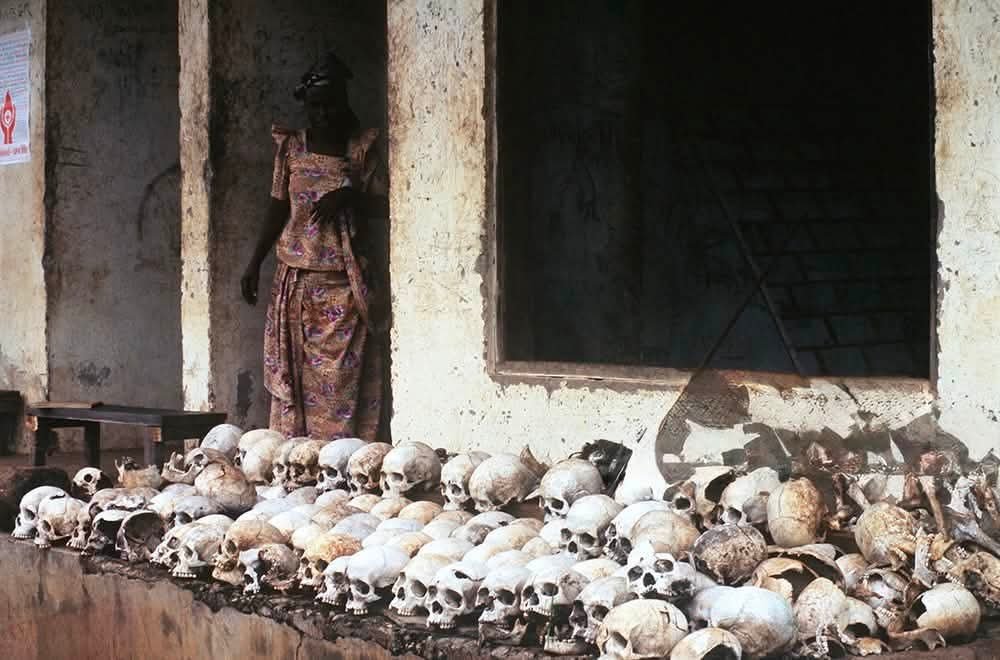
Rows of human skulls arranged outside a weathered building, with a woman standing among them. These remained in Luwero, Kiboga, and Nakaseke after the presence of National Resistance Army (NRA) rebels. This image is one of the better-known visual records of the aftermath of the Ugandan Bush War (1981–1986), also called the Luwero War.
It is not a scene of fresh destruction but a later memorial display of remains collected from mass graves and scattered sites across the Luwero Triangle, a fertile agricultural region north of Kampala that became the main theatre of the conflict.
The Luwero Triangle roughly encompassed parts of present-day Luwero, Nakaseke, Kiboga, Nakasongola, and surrounding districts. After the disputed 1980 elections that returned Milton Obote of the Uganda People’s Congress (UPC) to power, Yoweri Museveni and a small group of fighters launched a guerrilla campaign. The NRA established itself in the Triangle, drawing support from local Baganda communities and others who opposed Obote’s government.
By the early 1980s the area had become a liberated zone under NRA influence in which the rebels organised political education, collected taxes, and recruited. Government forces of the Uganda National Liberation Army (UNLA), drawn heavily from northern Acholi and Langi communities, responded with large-scale counter-insurgency operations.
Contemporary reports, Amnesty International documentation, and later academic studies converge on the conclusion that the majority of civilian deaths in the Triangle resulted from UNLA operations. In early 1983 the government launched Operation Bonanza, a major offensive that involved the forced removal of an estimated 750,000 people into military-controlled camps.
Civilians remaining outside the camps were frequently treated as rebel supporters and subjected to summary execution, looting, and destruction of farms and villages. International observers, including the International Committee of the Red Cross, later estimated that at least 300,000 people died in the Luwero Triangle under the Obote regime, with some broader estimates for the entire 1981–1986 period ranging from 100,000 to 500,000 across Uganda.
U.S. State Department assessments from the mid-1980s described the situation as “horrendous,” with tens of thousands killed or deliberately starved. Survivors and local officials reported UNLA soldiers returning north with looted goods and, in some cases, abducted girls.
The NRA was not free of responsibility for civilian harm. Scholarly analyses, including work by political scientist Jeremy Weinstein, document that the rebels carried out targeted assassinations of suspected government collaborators, informants, and UPC supporters. A smaller number of larger-scale killings occurred, particularly around 1983 when the NRA was under severe pressure and evacuating its main zone. The group also used child soldiers extensively and employed landmines. Overall, however, recorded incidents of violence against civilians attributable to the NRA formed a minority of the total; the rebels’ survival depended on local support, and their code of conduct emphasised restraint relative to the government forces.
Some NRA members later acknowledged that bodies of people killed by the rebels were sometimes buried in forests to avoid damaging the image of the struggle. After the war, certain Ugandan sources and political opponents of the National Resistance Movement continued to highlight these incidents and to argue that the NRA bore more blame for the Triangle’s dead than the official narrative allowed.
When Museveni’s forces took Kampala in January 1986, the new government organised the collection of thousands of skulls and bones from mass graves and roadside sites across the Triangle. These remains were placed in memorial structures and, for a period, displayed publicly. Museveni and the National Resistance Movement (NRM) presented them as evidence of the brutality of the Obote years and as justification for the armed struggle that brought them to power.
Academic studies of the “politics of the Luwero skulls” note that the memorials served a dual purpose: commemorating the dead while reinforcing the legitimacy of the post-1986 order by contrasting it with the preceding regime. Estimates cited by Museveni himself referred to roughly 70,000 skulls across about 30 mass graves in the area. Local residents and some researchers have pointed out that not every set of remains can be attributed solely to one side, that identification of individual victims remains incomplete, and that the political use of the skulls has at times sat uneasily with the concerns of surviving communities who still seek fuller accounting and recognition.
The districts named in the X post—Luwero, Kiboga, and Nakaseke—were among the most heavily affected. Contemporary accounts describe the destruction of villages, the emptying of productive farmland, and the long-term impoverishment of the region. Memorial sites continue to exist, though some have fallen into disrepair, and debates over their management and the historical narrative they support persist in Ugandan politics.
Claims that attribute the displayed remains primarily or exclusively to NRA actions represent a minority or revisionist reading of the available evidence. The weight of contemporaneous human-rights reporting, refugee data, and subsequent historical scholarship continues to assign the largest share of responsibility for the mass civilian deaths to the UNLA under Obote. At the same time, the existence of documented NRA abuses and the incomplete nature of post-war investigations mean that a complete, forensic accounting of every skull has never been achieved.
The image itself, showing orderly rows of skulls with a civilian figure present, is consistent with the memorial displays created after 1986 rather than an immediate battlefield scene. It stands as a stark visual reminder of a conflict whose human cost remains only partially quantified and whose political meanings continue to be contested more than four decades later.
📩 Email us: kamunyereports@gmail.com
📲 WhatsApp us: +256705569885
Your story matters—share it with us today! 🗞️🔥