Inside Story!! Why Museveni Dropped His Most Influential Veteran Ministers
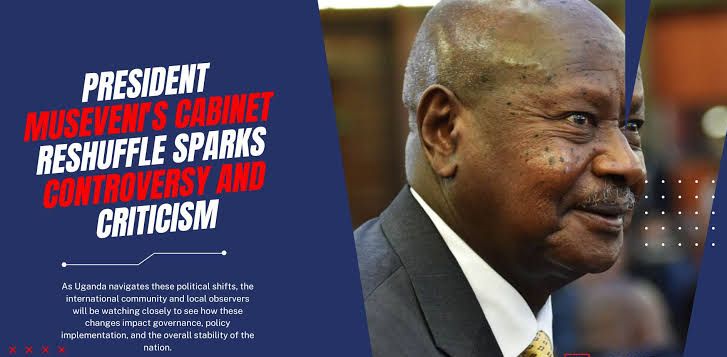
President Yoweri Museveni has officially revealed a fresh Cabinet structure for the 2026–2031 administration, introducing one of the most extensive government shake-ups witnessed in recent years, with several veteran ministers removed, powerful political actors reassigned, and critical economic and security portfolios significantly reorganized.
The latest appointments point to a major political reconfiguration within government as the ruling National Resistance Movement positions itself for another five-year term under Museveni’s stewardship. The reshuffle blends continuity in some of Uganda’s most sensitive ministries with the silent departure or redeployment of several seasoned political figures who have shaped Cabinet politics for decades.
In the official communication, Museveni stated that the appointments were effected in line with constitutional provisions governing executive powers, covering the offices of Vice President, Prime Minister, Cabinet Ministers, Ministers of State, and Senior Presidential Advisors.
Vice President Jessica Rose Epel Alupo has retained her post, preserving her role as Museveni’s deputy, while Prime Minister Robinah Nabbanja also survives the reshuffle and remains Leader of Government Business in Parliament.
Among the most notable developments in the new Cabinet is the elevation of former Speaker Rebecca Kadaga, who has been named First Deputy Prime Minister and Minister for East African Community Affairs. The appointment signals a major political resurgence for Kadaga after years of fluctuating influence within the ruling establishment.
Veteran diplomat and medical doctor Crispus Walter Kiyonga has been appointed Second Deputy Prime Minister and Deputy Leader of Government Business in Parliament, replacing Moses Ali, whose name is missing from both the Cabinet and Senior Presidential Advisors lists.
Meanwhile, Lukia Nakadama has been appointed Third Deputy Prime Minister and Minister without Portfolio, further boosting the presence of senior NRM figures within the highest ranks of government.
In one of the most closely monitored changes, Henry Musasizi has been named Minister of Finance, Planning and Economic Development, replacing longtime finance minister Matia Kasaija, who has been completely dropped from the new Cabinet lineup.
Kasaija’s exit signals the close of a significant chapter in Uganda’s economic administration. Over the years, he served in several influential government positions and was widely regarded as one of the regime’s most experienced economic managers.
At the same time, First Lady Janet Kataaha Museveni maintains her position as Minister of Education and Sports, guaranteeing continuity in one of government’s most sensitive and publicly scrutinized sectors. Her retention follows months of speculation linked to her health and reduced public visibility.
Within the Office of the President, Milly Babirye Babalanda remains Minister for the Presidency, while Jim Muhwezi continues supervising the influential Security docket.
Engineer Jonard Asiimwe has been appointed to lead the Ministry of Science, Technology and Innovation, a sector government increasingly considers central to economic modernization and industrial growth.
The reshuffle also confirmed the removal of several high-profile ministers from frontline Cabinet responsibilities. Former Energy Minister Ruth Nankabirwa and former State Minister Evelyn Anite have both been reassigned as Senior Presidential Advisors.
They join Francis Mwebesa and Hamson Obua in what political analysts are already describing as a calculated redeployment of experienced NRM mobilizers and loyalists away from direct ministerial administration into advisory positions closer to the presidency.
Several key ministries, however, remain largely untouched, indicating Museveni opted for continuity in sectors viewed as critical to public service delivery and political coordination.
Frank Tumwebaze remains in charge of Agriculture, Chris Baryomunsi retains the Health docket, while Jane Ruth Aceng continues overseeing ICT and National Guidance.
Opposition figure-turned-minister Norbert Mao also remains Minister for Justice and Constitutional Affairs, sustaining his controversial cooperation arrangement with the ruling administration.
Elsewhere, the announcement confirmed that Kenneth Omona has been transferred to the diplomatic service and will serve as ambassador, although his specific station is yet to be officially announced.
The reshuffle arrives at a politically delicate moment for the ruling NRM as the party seeks to strengthen internal power structures following the 2026 electoral cycle. Political observers say the new Cabinet reflects Museveni’s ongoing balancing strategy between rewarding loyalty, managing succession calculations, maintaining regional representation, and tightening control over strategic state institutions.
The absence of some historically influential figures, coupled with the elevation of others considered trusted insiders, is expected to spark renewed political debate within both government and opposition circles in the coming days.
Government is now expected to formally present the Cabinet list before Parliament for the required procedures, vetting exercises, and swearing-in ceremonies ahead of the start of the new administration.
📩 Email us: kamunyereports@gmail.com
📲 WhatsApp us: +256705569885
Your story matters—share it with us today! 🗞️🔥