Did UPDF Commandos Chew Bobi Wine’s Wife? Muhoozi Brags
Uganda’s political landscape has once again been stirred by controversial remarks from the country’s military leadership, reigniting public debate over the relationship between state security forces and opposition figures.
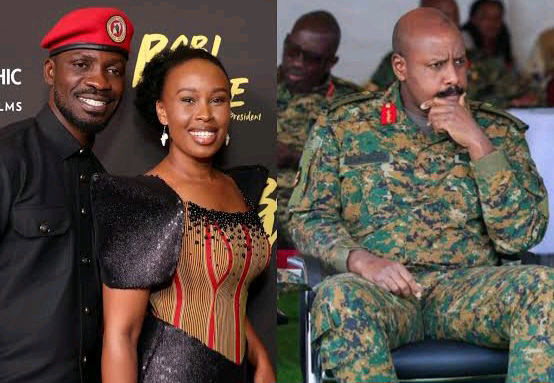
This time, attention has centered on statements made by General Muhoozi regarding opposition leader Bobi Wine and his wife, Barbie Kyagulanyi—comments that have intensified scrutiny of an already fragile political atmosphere.
The General’s remarks emerged amid claims circulating in the public space that soldiers assaulted Barbie Kyagulanyi during a security operation. Addressing the allegations, he dismissed them outright, firmly denying that any soldiers under his command would attack a woman. He emphasized that women are not targets of military operations and stressed that the focus of the operation was Bobi Wine himself, whom he described in harsh and dismissive terms. While the denial was intended to counter accusations of abuse, the language and tone used immediately sparked widespread discussion across the country.
In Uganda, statements from senior military figures rarely pass unnoticed. The military holds immense influence, and when its top leaders speak—especially on matters touching politics—citizens listen closely.
Such remarks often carry implications beyond their immediate context, raising questions about personal safety, civil liberties, and the broader political climate. When well-known political actors are involved, those concerns become even more pronounced.
Barbie Kyagulanyi occupies a unique position in Uganda’s public life. Beyond being Bobi Wine’s spouse, she is a visible public figure who has frequently appeared alongside him at political rallies, charity events, and public engagements. Over the years, she has become a recognizable and respected personality in her own right. As a result, any mention of her in connection with a security operation naturally evokes strong emotional reactions, public sympathy, and heightened concern.
While the denial of violence against her may reassure some citizens, others have focused on the tone and framing of the statement itself. In moments of political tension, language matters deeply. Many Ugandans believe that the way leaders communicate during sensitive situations can either cool tempers or inflame them further. Words, just like actions, have the power to shape public emotions and influence perceptions.
At the center of the controversy remains Bobi Wine, one of Uganda’s most prominent opposition figures. His journey from a celebrated musician to a lawmaker and political activist has transformed him into a symbol of change for many, particularly among young Ugandans. His strong grassroots support means that any security operation linked to him quickly becomes politically charged and emotionally loaded.
Supporters of Bobi Wine often view actions by security agencies against him with suspicion, interpreting them as politically motivated. Conversely, government supporters argue that security forces are merely performing their constitutional duty to maintain law and order. These opposing viewpoints highlight the deep political divisions within the country and explain why even official denials can fail to fully settle public doubts.
Political tensions rarely affect leaders alone. Families frequently find themselves drawn into the spotlight, sometimes unwillingly. Even when they play no direct role in political activity, their names can dominate headlines, social media debates, and public conversations. This exposure can create emotional strain and amplify public sensitivity around already volatile situations.
Women, in particular, are often viewed by society as deserving protection from political conflict. Allegations involving harm to a political leader’s wife therefore trigger especially strong reactions. Even when violence is denied, lingering questions often remain in the public mind, fueled by past experiences and mistrust.
Beyond domestic reactions, such statements also shape Uganda’s international image. Foreign governments, human rights organizations, and democratic observers closely monitor how political disagreements are handled. The use of strong military language in political contexts can raise concerns abroad, particularly among groups focused on human rights, civilian protection, and democratic norms.
Within Uganda, social media plays a powerful role in amplifying these debates. Statements spread rapidly, often stripped of context, and provoke immediate emotional reactions. In this fast-moving digital environment, calm and measured voices can easily be drowned out, allowing tension and misinformation to grow.
During moments like these, religious leaders, cultural elders, and community figures often step forward to urge restraint. They remind citizens and leaders alike that political differences should never escalate into violence or hatred. Their calls for peace become especially important when emotions are running high.
Legal experts also weigh in, emphasizing that all security operations must remain within the bounds of the law. Both allegations and official denials underline the need for transparency and accountability. Public trust in institutions depends not only on what is said, but on whether actions can withstand scrutiny.
The situation further highlights the close and often uneasy link between politics and security in Uganda. When political disputes involve the military, the stakes feel higher, and citizens begin to question whether disagreements are being managed through dialogue or force.
For the country’s youth—who make up a significant portion of the population—such developments are particularly influential. Many young people are already deeply engaged in conversations about leadership, democracy, and change. Dramatic political events can either inspire greater civic participation or breed fear and disillusionment.
Ultimately, the episode underscores the critical role of language in leadership. Strong or insulting words may project authority, but they can also deepen divisions and harden attitudes. In tense moments, careful communication can help prevent misunderstandings and reduce fear.
Public reactions continue to reflect a mix of belief, doubt, anger, and concern. Some citizens accept the General’s denial, while others question it. This range of responses mirrors the broader political divide within the country.
Incidents like this often become part of Uganda’s larger political narrative—one shaped by power struggles, opposition movements, and debates over governance. They are remembered not only for what occurred, but for how leaders spoke and behaved under pressure.
Having experienced political tension before, many Ugandans hope those lessons will encourage restraint and dialogue. Peaceful resolution of disputes remains the preferred path, especially when national unity and stability are at stake.
In the end, the situation stands as a test of leadership, communication, and public trust. While political rivalry continues, the shared hope among most Ugandans is for safety, stability, and a future where disagreements are resolved without fear, threats, or harm.
📩 Email us: kamunyereports@gmail.com
📲 WhatsApp us: +256705569885
Your story matters—share it with us today! 🗞️🔥