Why Museveni And Raila Odinga Hated Each Other? Inside The Dirty Politics, Betrayal And Money
On Monday, 15 August 2022, President Yoweri Museveni spent the better part of the afternoon and evening at State House, Entebbe, closely following the final tallying of Kenya’s presidential election results on television and over the phone.
According to sources, the weekly Cabinet meeting was adjourned earlier than usual to allow ministers time to track the climax of the hotly contested polls.
By 6pm, Museveni was fully engrossed in the broadcast as Kenya’s Independent Electoral and Boundaries Commission (IEBC) chairperson, Wafula Chebukati, took to the podium to declare the winner. Chebukati announced William Ruto as the president-elect with 7,176,141 votes (50.49%) against Raila Odinga’s 6,942,930 votes (48.85%).
The moment Ruto’s name was read out, Museveni raised his hands in quiet triumph and smiled. He remained seated, attentive to Ruto’s victory speech delivered moments later at the Bomas of Kenya. According to insiders, ministers at State House broke into jubilant celebrations that continued well into the night—up to around 10pm.
Later that evening, Museveni personally called Ruto to offer his warm congratulations. The following day, he followed up with an official letter in which he confirmed the phone call and extended further best wishes.
According to reliable sources, Odinga had previously tried to draw Museveni into his political orbit ahead of the 2022 elections. However, fundamental differences between the two proved difficult to overcome.
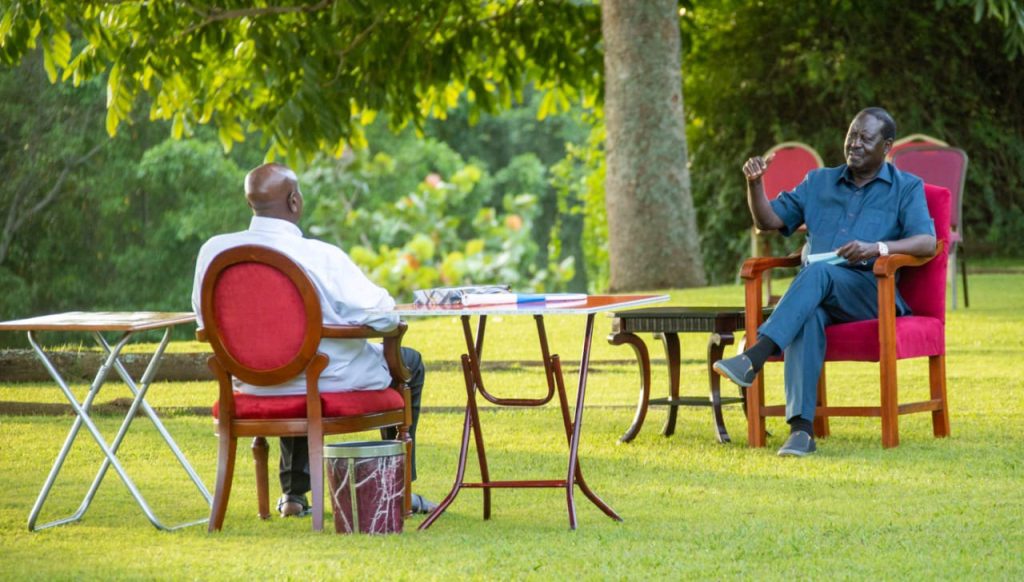
As the saying goes, “you can forgive but not forget.” The two leaders had met numerous times between 2010 and their most recent encounter in February 2024, engaging in both public and private discussions.

While sources say Odinga viewed these meetings as strategic opportunities to bolster his domestic political ambitions, Museveni approached them from a broader perspective—focusing on regional cooperation through bodies like the East African Community, African Union, and other multilateral frameworks. Museveni has often said he is open to working with anyone willing to buy into his regional vision, Odinga included.
In the build-up to Uganda’s 2011 elections, Odinga attended Museveni’s campaign rally. Prior to that, he had served as the chief fundraiser for Busoga University.
Later that year, in November 2011, the two reportedly met at David Hotel in Jerusalem, Israel, for a reconciliation talk brokered by Israeli Ambassador to Kenya, Gil Haskel. At the time, Odinga was serving as Kenya’s prime minister.
More public engagements followed. Odinga visited State House, Entebbe, in March 2012. A month earlier, on 18 February, Museveni had travelled to Odinga’s home region of Kisumu for a fundraiser for the Great Lakes University Education Trust Fund—an event they both graced.
The most recent meeting between them took place in February 2024, and this time, Odinga was accompanied by President Ruto.
Despite all these interactions, sources say the relationship between Museveni and Odinga never truly warmed.
So, what kept them apart?
A DIVIDE OVER GADDAFI
One of the most significant rifts between the two leaders reportedly occurred in 2011 over the NATO-led military intervention in Libya.
Museveni firmly opposed the airstrikes supported by the US, UK, France, and NATO to oust Libyan leader Col. Muammar Gaddafi. Odinga, on the other hand, was in support of the military approach.

During a meeting with then United Nations Secretary General Ban Ki-Moon in Nairobi in March 2011, Odinga stated that Gaddafi’s actions were “totally unacceptable” and praised the imposition of a no-fly zone over Libya, aimed at protecting civilians from government forces.
What particularly upset Museveni, according to sources, was Odinga’s public remarks after Gaddafi went into hiding. Odinga mocked the Libyan leader, saying, “A good general should know when the game is up. The war is over and Mr. Gaddafi’s side has lost. He should do the honourable thing now and let the people of Libya go. You can only govern people with their consent and Libyans have clearly shown that they want to move on from the Gaddafi era.”
THE BESIGYE-MBABAZI MEETING
Another major strain came in 2015 when Odinga hosted a political meeting in Nairobi between Uganda’s opposition figures—Amama Mbabazi and Kizza Besigye.
At the time, Mbabazi had broken ranks with Museveni and declared his intention to run against him in the 2016 presidential election. Besigye, a perennial challenger, was also gearing up for another face-off with Museveni.
Odinga welcomed them to his Karen residence in a bid to broker unity among Uganda’s opposition. Other political figures including Ambassador Olara Otunnu, the late Mathias Nsubuga, and Wasswa Biriggwa also attended. Odinga reportedly urged them to form a united front, suggesting it was the only realistic path to unseating Museveni.
FALLOUT FROM 2007 ELECTIONS
Even though Museveni and Odinga have crossed paths numerous times, sources say the latter never quite got over Museveni being the first foreign head of state to congratulate Mwai Kibaki after Kenya’s disputed 2007 elections—an outcome Odinga challenged vehemently.
ICC CONTROVERSY
Another point of contention came in 2008, when the International Criminal Court (ICC) indicted both Ruto and then-President Uhuru Kenyatta for their alleged roles in Kenya’s post-election violence.
Odinga, having lost the 2007 election, supported the ICC’s involvement. Museveni, however, was of a different view—arguing that Kenya should handle the matter internally and that the ICC was overreaching.
In 2013, Museveni publicly slammed the ICC as “arrogant and shallow,” adding: “Many African countries supported the setting up of the ICC because we abhor impunity. Our advice to them is from very capable actors who know what they are doing and saying. Kenya is recovering. Let her recover. We know the origin of past mistakes. The ICC way is not the right one to handle those mistakes.”
He reiterated this stance at Kenyatta’s presidential swearing-in, going so far as to threaten a motion at the African Union calling for African nations to withdraw from the Rome Statute, which established the ICC.
📩 Email us: kamunyereports@gmail.com
📲 WhatsApp us: +256705569885
Your story matters—share it with us today! 🗞️🔥