Minister Otafiire Blasts M7’s Govt Over Besigye’s ‘Illegal’ Detention: “This Is a Betrayal of Justice”
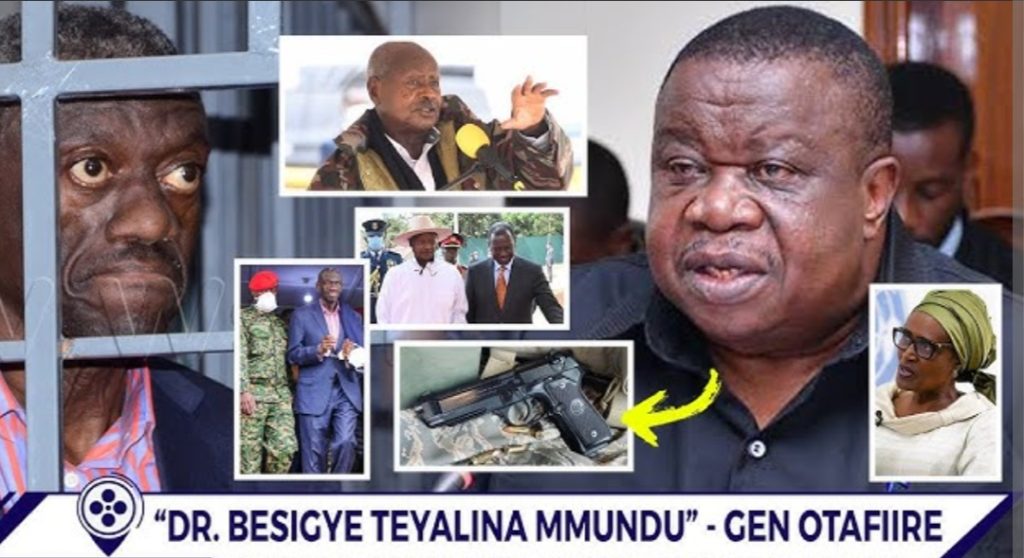
Uganda’s Minister of Internal Affairs, Maj. Gen. (Rtd) Kahinda Otafiire, has launched a searing condemnation of the continued detention of opposition figure Dr. Kizza Besigye, denouncing it as a blatant affront to justice and constitutional order.
Speaking at the Sam Kalega Njuba Memorial Lecture in Kampala on Thursday, Otafiire didn’t hold back. In an unusually candid speech for a top government official, he demanded that the state either produce charges against Besigye in court or set him free immediately.
“How can someone be held for eight months without appearing before a judge?” he asked, his voice laced with frustration.
A veteran of Uganda’s liberation war and a prominent member of the ruling National Resistance Movement (NRM), Otafiire emphasized that even if Besigye had committed an offense, justice demanded a legal process—not indefinite detention. Holding a man without trial, he argued, was not only unconstitutional but a violation of human decency.
Until due process is followed, Otafiire insisted, the public will continue to see Besigye as an innocent man.
Anticipating criticism from within his own political circles, the minister didn’t flinch. “Speaking the truth,” he declared, “matters more than blind loyalty.”
He warned starkly that if Uganda abandons the rule of law, it risks descending back into the dark, violent chapters of its past.
Drawing on history, Otafiire recalled the brutal days under Idi Amin’s regime. In a chilling anecdote, he recounted a man who was publicly pardoned by Amin, only to be found dead near the president’s residence shortly after.
“That kind of betrayal and lawlessness,” he said, “is what compelled us to take up arms.”
Letting such injustice re-emerge, he warned, would be a betrayal of everything Uganda’s freedom fighters once stood for.
Otafiire reserved particular criticism for the Directorate of Public Prosecutions (DPP), blasting the office for failing to provide any legal justification for Besigye’s continued incarceration. “If the state can’t explain what crime he committed,” he said, “it has no right to keep him imprisoned.”
Besigye, a former physician to President Museveni and now a fierce critic of the government, was arrested earlier this year during protests over rising inflation and alleged corruption. A four-time presidential challenger, Besigye has become a symbol of opposition defiance in Uganda—and a frequent target of state arrests.
His latest detention has triggered widespread condemnation, both within Uganda and internationally, with legal experts and human rights groups calling it unconstitutional.
Using the memorial lecture as a moment of national reflection, Otafiire likened Uganda to a vehicle. “When it veers off course, it is the responsibility of those at the wheel to correct its direction before it crashes,” he said.
He called on leaders across political lines to embrace dialogue, not force, to resolve differences—warning that civil conflict leaves no winners, only wounded survivors.
Otafiire sharply criticized the use of legal technicalities and brute force to crush dissent, warning that such tactics only deepen rifts and sow instability.
“Uganda cannot afford to repeat the cycles of internal strife that have already scarred our history,” he cautioned.
He argued that opposition voices must never be criminalized, warning that the greater danger lies in governments that refuse to acknowledge and rectify their own errors.
Reflecting on his days as a soldier, Otafiire offered a sobering insight: “The greatest generals aren’t those who win battles with guns, but those who avoid war altogether.”
He lamented that Uganda is still paying off debt from weapons bought during Amin’s rule—arms that, as he put it, “were turned against Ugandans themselves.”
True national strength, Otafiire asserted, is not built on repression, but on justice, honesty, and fairness.
He urged both ruling party members and opposition leaders to have honest—even uncomfortable—conversations. “How can a government understand its people’s needs,” he asked, “if it shuts them out of the national dialogue?”
Justice, he concluded, must not be a privilege reserved for the few, but a universal right.
“Every protest,” he said, “must be examined within a fair legal framework, even if it’s unpopular.”
Reminding the audience that a trial isn’t just a path to punishment but also a possible acquittal, Otafiire stressed that what truly matters is unwavering respect for the rule of law.
He made it clear: this is no longer just about Besigye’s personal liberty. “What’s at stake is the credibility and integrity of our entire justice system.”
“When a state chooses to violate its own laws,” he warned, “it risks eroding the very foundations of the nation.”
His words sparked a stir. Some in the audience rose in a standing ovation—others sat still, visibly uneasy with the gravity of his message.
📩 Email us: kamunyereports@gmail.com
📲 WhatsApp us: +256705569885
Your story matters—share it with us today! 🗞️🔥